The AI that knows your infrastructure
before you type a word.
Ask questions, request actions, or delegate complete workflows. AI Pilot reads your full cloud state at session start and operates with your explicit approval, every step, every time.
assets/aipilot-hero.mp4
Rename your existing AI Pilot screen recording to aipilot-hero.mp4 and place it in the assets/ folder. It will autoplay muted on loop.
Prefer a static screenshot instead? Replace the video tag with <img src="assets/aipilot-workspace.webp">.
Three operational modes
Choose the level of autonomy for each task. Switch modes mid-session without losing context.
Read-only. No exceptions.
Questions and analysis only. Nothing is touched
AI Pilot reads your infrastructure and answers questions about what it sees. No commands run, no configurations change. Use this to investigate, diagnose, and understand your environment.
See every step before it runs.
Full execution plan generated and presented for review
Request an action and AI Pilot maps out the complete sequence before anything executes. You review each step, approve or modify, then confirm. Nothing runs until you say so.
Full execution, with gates.
End-to-end task completion. Destructive steps require explicit confirmation
AI Pilot handles the full task sequence. Standard operations proceed. Destructive or irreversible steps stop and require you to type the exact action name before proceeding. No clicking through.
A dedicated workspace, not a floating button.
AI Pilot has its own full-screen environment inside CloudAIPilot, with persistent conversation history and session context wired to every server, service, alert, and metric you have connected. Your entire cloud, in one conversation.
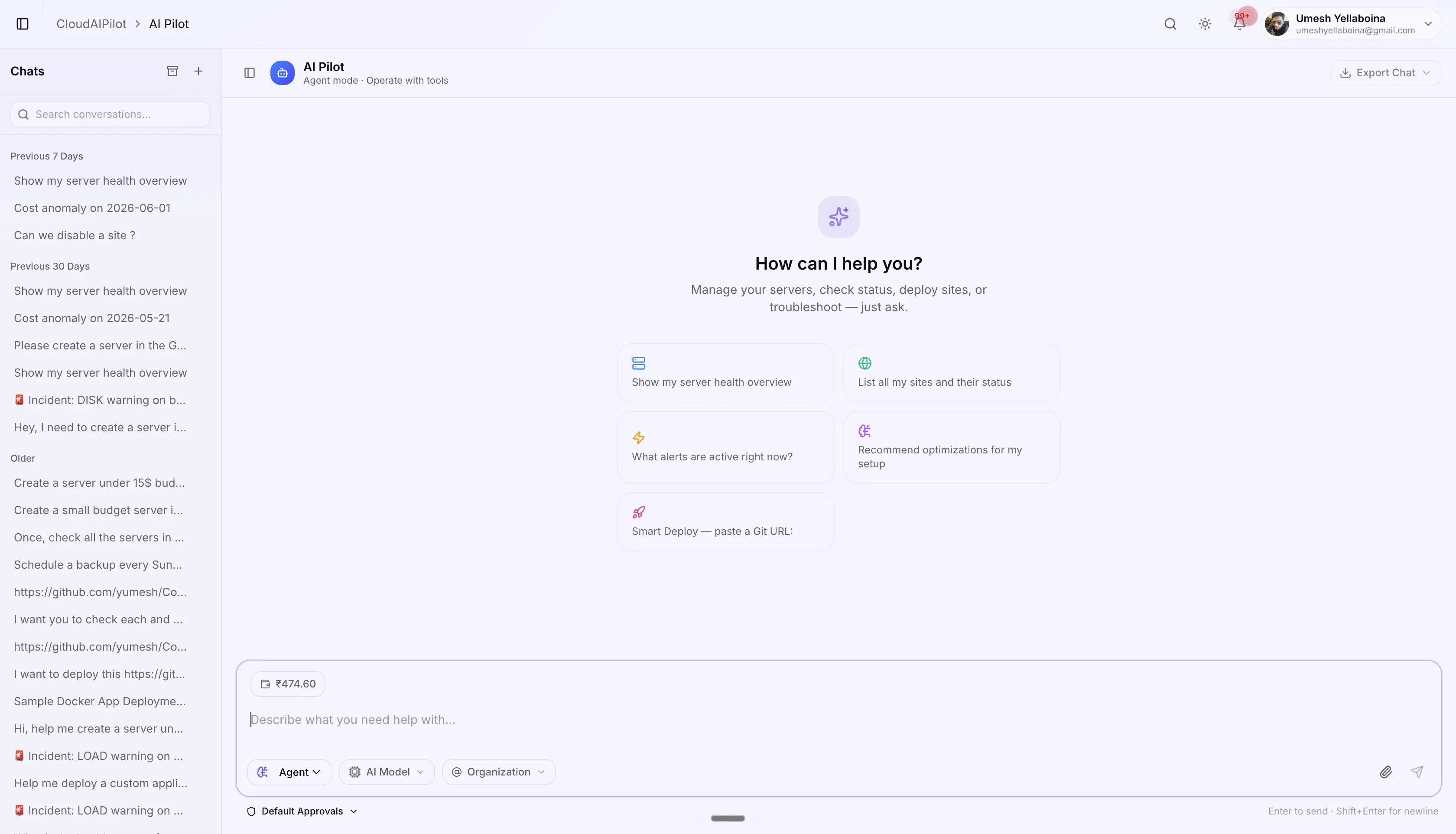
Persistent session history
Conversations are saved and searchable. Refer back to past decisions and executions.
Model + context selector
Switch models or scope the AI to a specific server, team, or project mid-session.
Live infrastructure state
Every message is answered with current data, not cached snapshots.
93+ tools, always available
All tool domains are active unless you've disabled them in governance settings.
It arrives briefed.
Before your first message, AI Pilot has already read your infrastructure state: live, from your connected cloud accounts. Every answer is grounded in what's actually running right now.
All connected servers
Specs, region, OS, installed packages, running services, SSL certificate status, and current health.
Real-time & historical metrics
CPU, memory, disk, network, I/O, live and up to 30 days back. Ask about a spike from last Tuesday.
Logs and events
Nginx, Apache, application logs, and system events, searchable and correlated with infra state.
Deployment and change history
What deployed, when, by whom, plus config changes, backup outcomes, and alert history.
Active alerts and their context
Current alert state correlated with the events and deployments that likely caused them.
Cost data by service and provider
Current spend, trends, and waste signals from all connected cloud accounts.
Plans before acting. Confirms before executing.
No AI action runs without your review. Every execution starts with a proposal: a numbered sequence of exactly what will happen, in what order, and why.
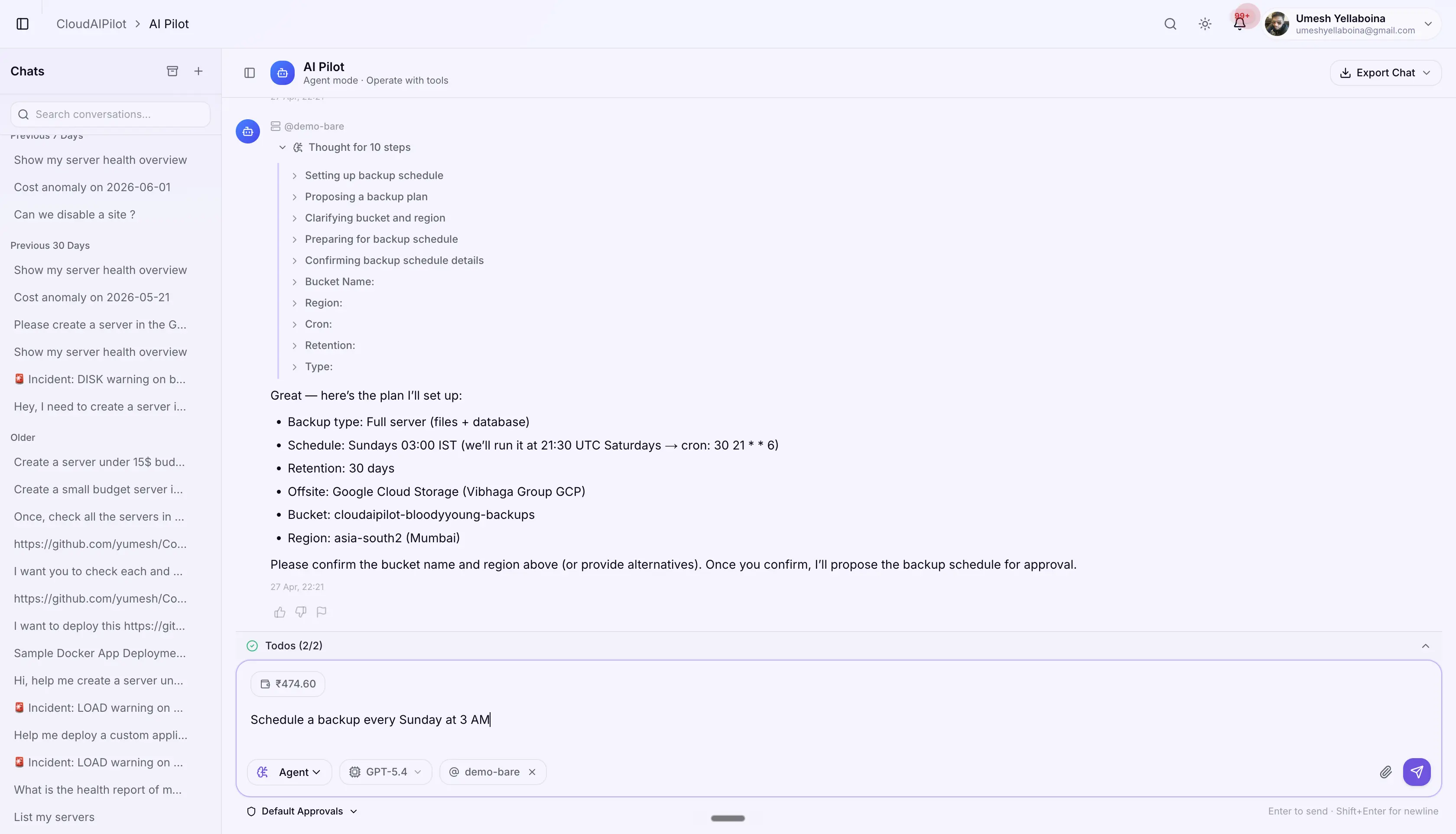
Step-by-step execution proposal before anything runs
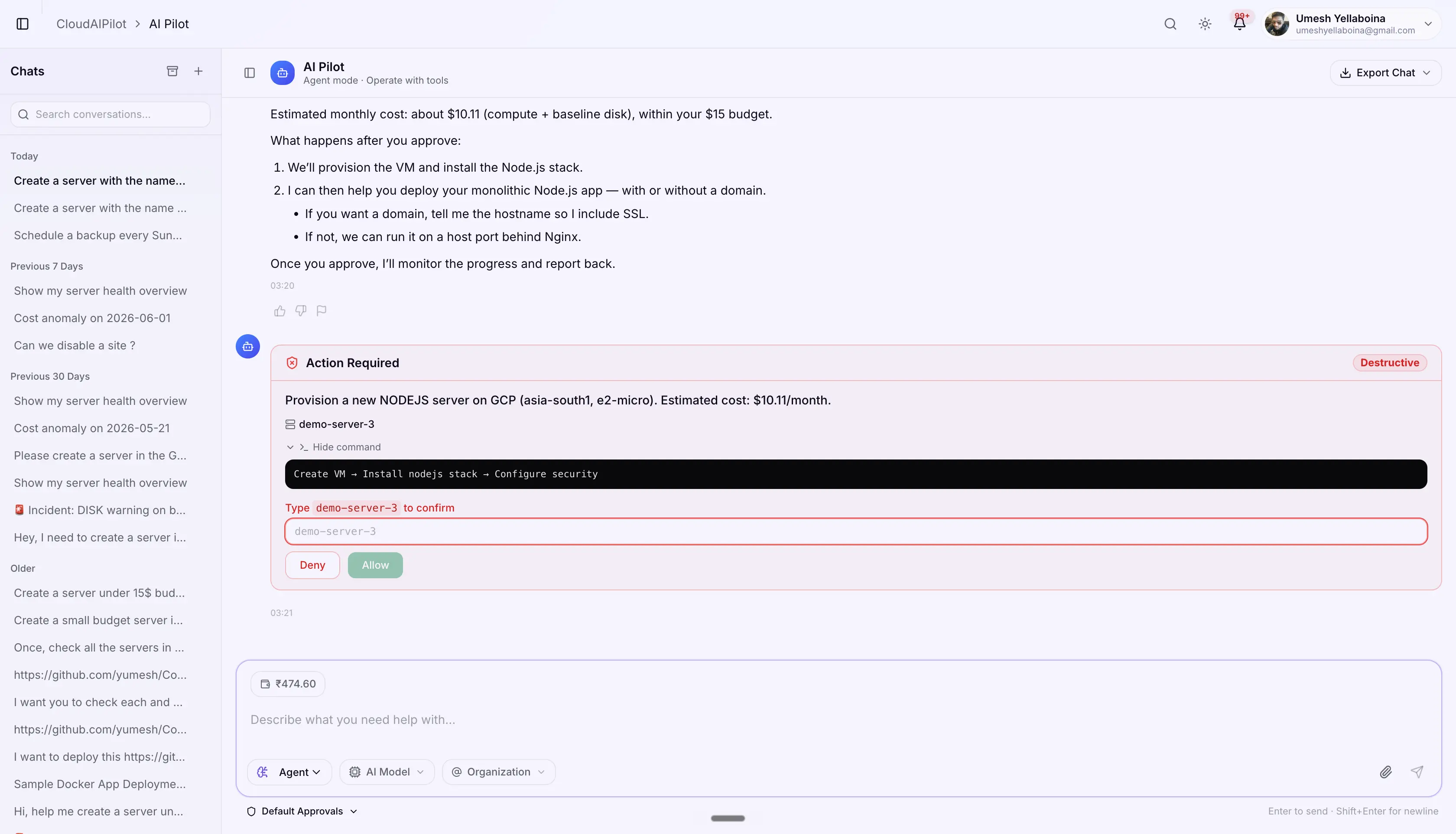
Type-to-confirm gate on destructive operations
Purpose-built governance,
not an afterthought.
Most AI tools add a confirmation dialog and call it safe. CloudAIPilot's AI governance layer was designed from the ground up for cloud infrastructure operations, where a single wrong action can take down a production service, corrupt a database, or delete years of data. After extensive research and real-world testing across production environments, we built a five-stage evaluation architecture that sits between AI intent and your infrastructure. Every tool call passes through it. No exceptions.
Master Kill Switch
One toggle disables all AI-initiated actions across the entire platform. Reads and questions remain available. No execution can occur while the master switch is off. No overrides, no exceptions, not even for admins.
Domain Toggles
Each operational domain (Server Operations, App Deployments, Database Operations, Network Changes, Storage Operations) has an independent on/off switch. Disable database tools entirely while keeping server tools active. Supports zero-trust segmentation for multi-role teams.
RBAC Integration
AI tool access is bound to the same role permissions as manual actions. A team member with read-only access cannot trigger AI operations they couldn't perform manually. There is no privilege escalation path through the AI layer: the governance system checks the acting user's role, not the AI's capabilities.
Production Protection Flags
Individual servers, databases, and resources can be flagged as production-protected. Protected resources receive stricter confirmation requirements, are excluded from bulk operations, and surface additional warnings on any change, even from admin roles.
Confirmation Gates
Destructive operations (deletes, restarts, data migrations, configuration overwrites) require typing the exact action name before execution begins. This is not a checkbox or a "yes, proceed" button. It requires deliberate, specific input that cannot be automated, scripted, or bypassed.
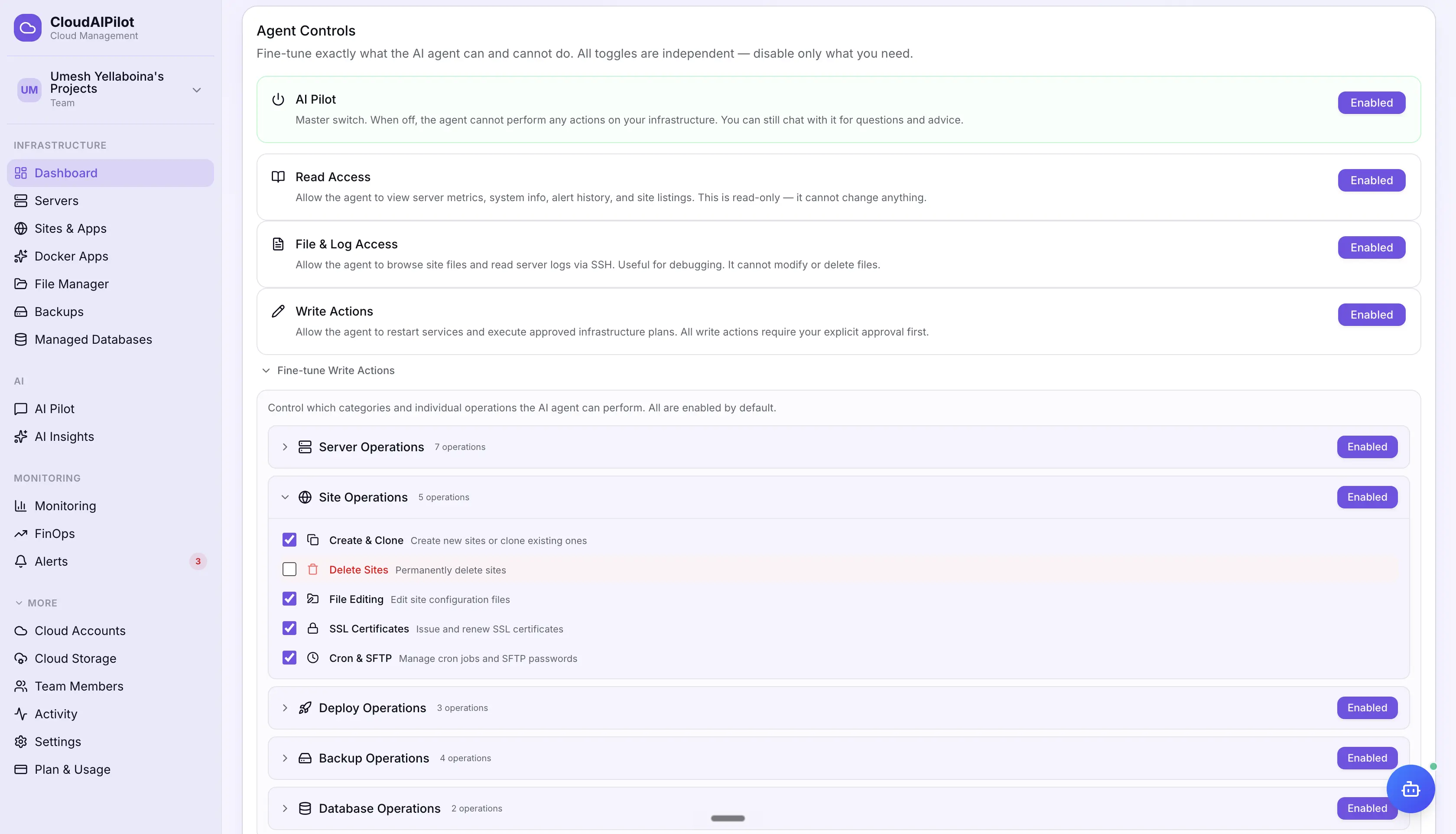
93+ tools across 9 domains
Every tool is purpose-built for cloud infrastructure, tested against real environments, and governed by the access policies you configure. None of them run without your approval.
Server Operations
18 toolsProvision, configure, restart, resize, migrate, SSH access, package management, service control, and user management.
Application Deployment
14 toolsGit-based deploy, rollback, build pipelines, env var management, zero-downtime strategies, and deployment history.
Docker & Containers
12 toolsImage management, Compose stacks, container log inspection, service updates, volume management, and registry auth.
Database Operations
11 toolsQuery, optimize, backup, restore, and monitor PostgreSQL, MySQL, and MongoDB. Slow query analysis and index review.
Security & Hardening
10 toolsFirewall audit, SSH key management, open port scanning, SSL certificate monitoring, fail2ban, and sudoers review.
Monitoring & Diagnostics
9 toolsRead metrics, correlate events with deployment history, investigate alerts, tail logs, and run diagnostic sequences.
Backups & Recovery
7 toolsTrigger manual backups, restore from point-in-time, verify backup file integrity, and manage retention policies.
Git & CI/CD
8 toolsGit provider integration, branch-based deployment, webhook triggers, pipeline management, and deployment history tracking.
FinOps & Cost Analysis
6 toolsQuery spend by service and provider, identify waste patterns, compare instance pricing, and generate cost reports.
The same governance layer. Your choice of model.
AI Pilot routes requests through whichever model you've configured. Every model connects to the same tool library and governance layer. Switch mid-session or set a default per-organization.
Strong infrastructure reasoning, careful multi-step planning, and long-context analysis across complex operations.
Strong general reasoning and fast responses for routine operations and quick queries.
Available for teams with existing Gemini API access. Connects to the same tool and governance layer.
Run models locally on your own hardware. No data leaves your environment. Zero external API calls.
Enterprise onlyYour data is not used to train AI models. CloudAIPilot connects to AI providers through their official APIs only, not consumer products. Per their published API usage policies, Anthropic, OpenAI, and Google do not train their models on data submitted through API calls. This is a contractual commitment in their API terms, not just a preference setting.
Memory spike started at 14:32, 18 minutes after user-service was updated to v2.2.0. That version's container baseline is 340MB larger than v2.1.3. Current free memory: 180MB. Two options: restart the container to recover ~1.2GB of leaked heap, or roll back to v2.1.3 entirely.
From alert to diagnosis in seconds.
When an alert fires, AI Pilot can be the first responder. It reads the full alert context (correlated metrics, deployment timeline, recent changes, log entries) and presents a specific diagnosis and remediation plan.
Not generic advice. Infrastructure-specific analysis grounded in what's actually running in your environment.
Correlates with deployment history
Knows what changed and when, so it can point to the likely cause immediately, not generically.
Proposes concrete steps
Not "check your memory usage": specific actions targeting your specific servers and services.
Requires your approval
Presents the plan. Nothing executes until you confirm, even at 3 AM when you're half-asleep.
"The fastest way to understand it is to use it."
Try AI Pilot free.
Available on every plan, including the Forever Free tier. Connect your cloud accounts in minutes.
Sign up free · Connect your existing AWS, GCP, Azure or DigitalOcean account · AI usage is billed from your Cloud Wallet